Concept · Mercado Play · Not shipped
Social discovery that works on day one
People recommend titles all the time, on WhatsApp, and the context is gone before they open the app. An independent concept, built on a scenario brief, for a system that works before anyone has a network.
Brief for

Role
Product designer, independent
Type
Concept on a scenario brief
Platform
Mercado Play, mobile
Status
Not shipped

Scope
Designed: the Recommended tab, connection by link and by contacts, recommending from any title, and the empty and error states across all of it.
Left out on purpose: categories by relationship, reactions and replies, group recommendations. Each is a defensible next step; none is needed for the loop to close.
The brief’s premise: usage frequency down 4% month over month.
The problem
The recommendation survives. The context doesn’t.
Someone hears about a series at work and messages it to themselves so they don’t forget. Someone else ignores critic scores and only acts on what people she knows tell her. An older viewer wants to open the app and find what his family picked. A son googles actor names because his father can’t remember the title.
By the time anyone opens the app, the title, the sender and the reason are gone. A recommendation is a reason to come back. When it dissolves outside the product, so does the return visit.
Assumptions
Hypotheses, not findings.
They came from the scenario, not from research I ran. Each one comes with how I’d test it.
Trust is social before it’s algorithmic.
How I’d test it
Compare play-through on peer-attributed titles against algorithmic rows.
Remembering is the real friction.
How I’d test it
Measure the gap between when a title is mentioned outside and when it’s played, if ever.
The behaviour already exists off-platform.
How I’d test it
Survey how people save titles others mention today.
There’s nowhere for it to land.
How I’d test it
Usability sessions on where people expect to find a title someone sent them.
Benchmark
Why the category never solved it.
Four products with the same problem. None landed a lasting answer.

Netflix
Friends (2004–2010), then Facebook integration. Both abandoned.
Shareable links out, with no social graph.

HBO Max
Never built peer recommendation.
Synchronous co-watching. Answers “now”, not “when you can”.

Apple TV
No in-app social graph.
Messages is the layer: a Shared with You row, with the sender’s name.

IMDb
Years of documented user requests.
Public list URLs. Never shipped.
The wall
In paid streaming, a recommendation is an invitation to a purchase. Mercado Play is free. The wall isn’t there.


Cold start
Manual following
Friend requests
Invite link, 7 days
Attribution
Full, feed-wide
Named, semi-public
Private thread
Directed sending
None, by design
Buried in redesigns
Core of the feature
What I took
From Apple: the messaging layer people already use is the social graph. The product gives what arrives a place to land.
From YouTube: link-first connection, with consent from the person receiving.
From Letterboxd: attribution with a face and a name, not an aggregate score.
What I left out
Broadcast feeds. People came to watch something tonight, not to perform taste.
Contact permission as the price of admission.
Retry loops. Low usage is a demand problem, not an attention problem.
How might we
let people recommend, receive and act on content from people they trust, without needing a network to exist first?
The constraint that shaped everything: it has to be useful to someone who has connected with nobody, on their first day, or it never gets a second one.
The flow
Two ways in, one loop.
The link path works before any graph exists. If the recipient doesn’t accept, the flow ends. No push or email retries.

Screen by screen
Entry, connection, the hub, recommending.


Invite with a link
The native share sheet, with no title attached. On day one there’s nothing to attach, so the copy carries it.
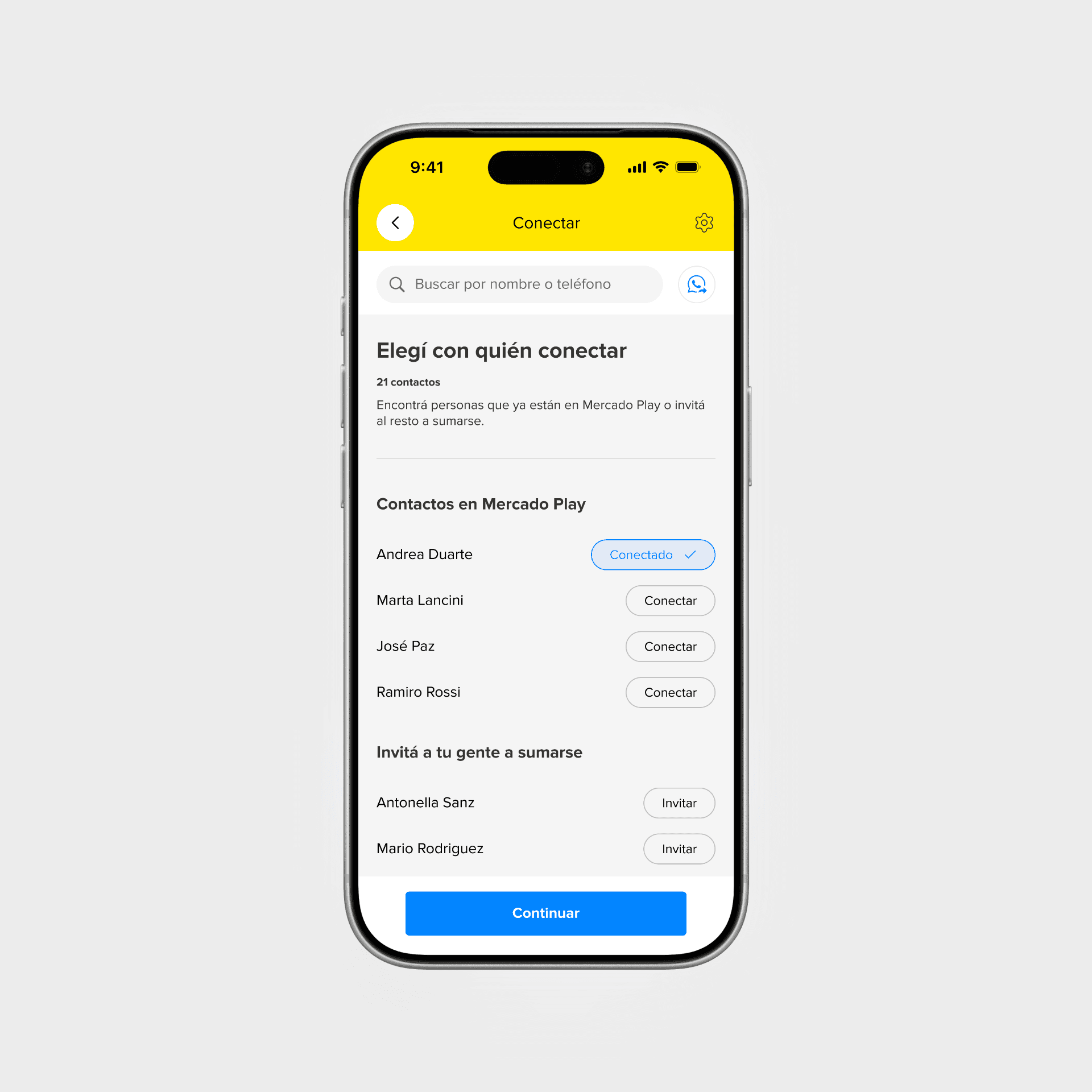
Connect from contacts
Split in two: people already on Mercado Play, and people who get an invite.
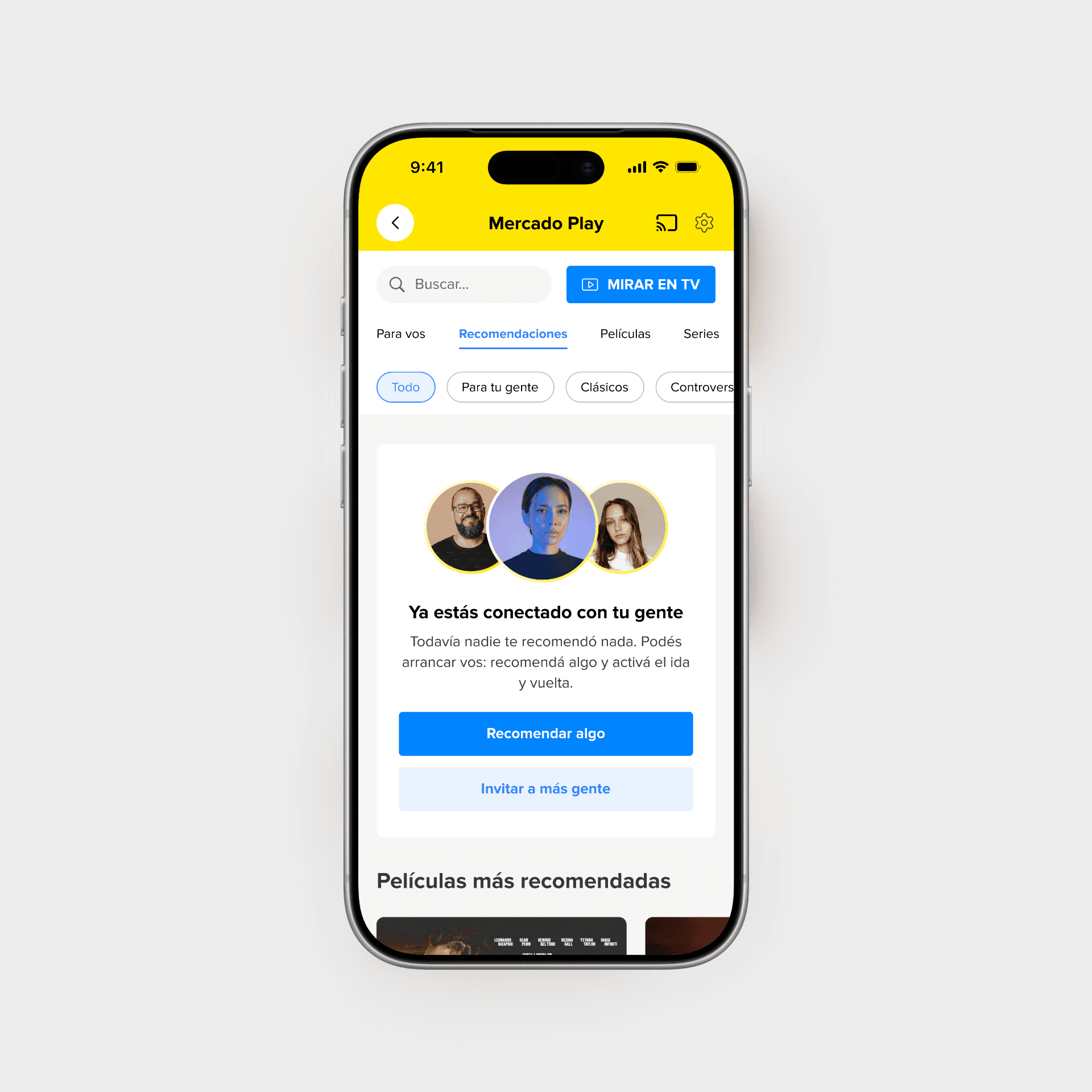
Connected, nothing received
Pushes you to send the first recommendation instead of waiting. Seeding beats waiting.

The hub
Titles carry a face, a name and a rating from the person who sent them. Attribution, not aggregation.

Recommend from any title
Two taps from the title page. It works before you’ve connected with anyone.

Recent contacts and a note
Pick recent people or share by link, and add an optional note.
Decisions
Five calls, and what I said no to.
01
Primary action
Chose
Invite with a link.
Rejected
Connect your contacts first.
Why
Every product that made peer recommendation work avoided making the address book a requirement.
02
Naming the secondary
Chose
“Ver mis contactos”: named for what it does.
Rejected
A label about the permission it needs.
Why
The system dialog only appears once the intent is explicit. An earlier version had the hierarchy backwards and pulled attention from the primary.
03
Day-one invite
Chose
The invite carries no content.
Rejected
Wait until there’s a title to send.
Why
A first-time user has nothing to recommend. The invitation has to stand on its own, which puts the weight on the copy.
04
Permission denied
Chose
Return to the link path.
Rejected
Send people to settings, or ask a second time.
Why
Refusing a permission is a valid answer, not an obstacle to route around.
05
Ignored invitations
Chose
The flow ends.
Rejected
Push and email nudges, re-education screens.
Why
Chasing people treats a demand problem as an attention problem.
States & edge cases
A recommendation system spends most of its early life empty.
Those states are the product, not an afterthought.

E1
Nobody connected yet
Explains what will appear and offers both entry paths. Personal rails stay below.
E2
Connected, nothing received
Shows who you’re connected with and pushes the first send.
E3
Contact search, no results
Offers phone lookup or an invite link instead of an empty list.
E4
Send failure
Keeps the note already written and offers a retry.
E5
Permission denied
Back to the link path. No settings redirect, no second ask.
E6
Invitation declined or ignored
The flow ends. A deliberate removal.
How I’d measure it
There are no results to report. This is what I’d instrument.
Primary
Usage frequency
The premise was a 4% drop. The test is whether returns rise among people who receive a recommendation.
Secondary
Peer vs algorithmic play-through
Plus time from receiving to playing, and the share of invites that become a connection.
Health
Senders vs receivers
If 5% send and 95% receive, it’s a broadcast channel, and the design failed at its own premise.
First A/B test
Link-first vs contacts-first entry
Measured on completed connections, not permission grants. The decision the whole architecture rests on.
What I took from it
The empty state carries the strategy.
A network-first feature never gets a network.
The design problem isn’t the populated state. It’s the first day.
Permission gates tax the least confident user.
The person who most needs recommendations handed to them is the least likely to grant contact access.
Attribution is the feature.
Strip the face from a recommendation and you’ve rebuilt an algorithm with extra steps.
What the empty state asks for is the strategy.
It reveals whether the system expects people to wait or to start.
Keep reading
4 pieces · 3 cases, 1 concept
If your product got complicated, let’s talk.
Copy email
All contact details